Archive for category Alberta
Alberta 2012 Leadership Debate
Posted by gordonmcdowell in Alberta, Calgary, Politics on 2012-04-17
On 2012-04-12 (April 12th, 2012) the leaders of Alberta’s political parties faced off for a debate. All except Glenn Taylor for Alberta Party. I’d spoken to Glenn previously, and would have very much liked to have seen him participate in the debate.
So I hope you enjoy the “Alberta 2012 All Candidate Leadership Debate“.
Alberta Party let me video their War Room. Glenn was responding to debate questions in real time via a team of people monitoring various online communication channels. After the debate, Glenn restated the full answers on video.
I edited that after-the-debate video footage appropriately into the broadcast debate timeline. Also included (in real chronological order) are the creation of responses Alberta Party posted online during commercial breaks.
There was a lot more War Room action during the debate, but I didn’t want to cut away from any of the other 4 candidates, or interrupt the flow of the debate. So I stuck to commercial breaks.
I do hope anyone who hasn’t yet watched the debate does so with this version. It contains all the debate footage. No opening or closing statements are missing. And it includes Alberta Party responses. Yet is is shorter than the broadcast version.
LFTR in 5 Minutes – A video about THORIUM created for Elizabeth May and Canadian Greens
Posted by gordonmcdowell in Alberta, Calgary, Canada, Environment, thorium on 2011-10-21
LFTR in 5 Minutes starts with a fast-paced summary of why thorium needs to be developed as an energy resource. If you follow gadget, technology or science blogs, then you’ll likely find thorium a fascinating subject.
In a nutshell, today’s nuclear power (Pressurized Water Reactors – PWRs) are incredibly inefficient. We still use them because, as inefficient as they are, fission releases an astounding amount of energy from tiny amounts of fuel (Uranium-235). The trade-off between high energy density and PWR inefficiency is: nuclear waste. PWRs generate a lot of nuclear waste.
LFTR has the potential to not just generate less waste going-forward, but consume existing stockpiles of waste. LFTRs can be constructed less expensively than PWRs because engineered safety systems can be replaced with (less expensive) passive safety systems, large pressure vessels are no longer required, and small/inexpensive gas turbines can replace large/inefficient steam turbines.
Any & all arguments against nuclear power must be re-thought when looking at the Liquid Fluoride Thorium Reactor. In particular, anyone concerned with climate change owes it to themselves to bone-up on this subject.
In my opinion, PWRs (today’s nuclear power) have already been maligned by environmentalists as dangerous and expensive. While I do think today’s PWR technology fails to completely answer the challenge of global warming, it illustrates how concerns about greenhouse gasses are easily redirected to promote specific technologies (solar, wind, geothermal) which are expensive and cannot be rapidly deployed.
Are we talking about the same global warming here? That global warming which may (thorough its destabilizing effects) set humanity’s progress back hundreds of years? That will displace millions of people living at sea level? That the impact of cannot be reliably predicted past an uncertain “tipping point”?
Bad, scary stuff. But not as scary as nuclear power, apparently.
I have tried to engage Elizabeth May, leader of Canadian Green party (and currently the only elected Canadian Green MP) on this subject. I like her. I’ve voted for her. She is smart, and should she choose to fully engage on this topic I have no doubt her arguments would be well thought out. However it appears she’s only willing to research arguments against, and leave it at that.
I handed a 10 minute video to Elizabeth May back in November of 2009. I’ve handed an early screener of THORIUM REMIX 2011 to her, and tried my best to engage her on this subject. To the best of my knowledge, the only information Elizabeth has consumed on the subject of LFTR is anti-nuclear arguments from the Canadian Coalition
for Nuclear Responsibility which included the following:
It may be that, one day, after all the power reactors have been shut down and folks have weaned themselves off of nuclear power, some version of these concepts may be useful for waste management purposes. But not now! To do it now would just be unleashing the dogs of nuclear expansionism, leading to a mad flurry of activity that the whole world will end up regretting. - Dr. Gordon Edwards
Do I have to explain why I find it troubling this is the Green Party of Canada’s go-to-guy on matters of nuclear technology?
My proposal to Elizabeth May (now an open letter since she has not replied to my email) is this: You moderate a discussion on the subject. You pick the anti-LFTR speaker. You OK the venue (assuming I can arrange something).
This way (Elizabeth), no one is expecting you to be an expert on nuclear power. You’re not being put-on-record. You’re there to be satisfied the discussion is fair. You can direct it towards whatever avenues you find most troubling about the technology. And most important of all, you’ll be in-the-room as an intelligent conversation about LFTR takes place. Sound good to you?
Elizabeth May is a Busy Person
I can’t imagine the workload required of a sitting MP who is also the leader of a federal Canadian political party. Elizabeth I know you’re busy. Clearly busier than me as I had time to put together the video (and that took a long time).
But we can not afford to make a mistake on this. If you overlook a high-density, non-greenhouse-gas emitting source of energy, you are gambling that a political agreement will ultimately result in lower CO2 emissions. Not lower CO2 emissions per-captia. Not improvements in energy intensity. None of that ultimately matters. We need to lower total CO2 output, and keep it low through both good economic times and bad.
How’s that been working out so far?

Kyoto wasn’t even an agreement that halts global warming, just something to get the ball rolling on lowering carbon emissions. How do you think this is going to play out once the effects of climate change impact the economies of western nations? Will cooler heads prevail? Will we all buckle down and implement more cap-and-trade and carbon-tax measures? Or is this going to turn into a scapegoat-fest the likes of Rupert Murdoch could only dream of?
What do you think is going to get blamed for an economic downturn? The ripple effects of global warming? Or those darn environmentalists and their tax-and-regulate hatred of freedom?
If politics had a useful “tipping point” on this subject, it would have reached hit long ago. (An Inconvenient Truth came out in 2006.) Likely that tipping point will coincide with the planet’s: All of a sudden our choices will be extremely narrow (if we are left with any choices at all). This may be the last decade in which our choices aren’t all bad ones.
Despite my skepticism that focusing on legal agreements will help us avert disaster (and I concede it did work with acid rain), I’m still happy to help on that front. I want to see Canada meet its Kyoto obligations. I want a carbon tax (or cap-and-trade). I want the Canadian Green Party to continue to speak on this issue, as your presence in the House of Parliament allows us to do.
However, I’m not doing that at the cost of handicapping technological solutions to the climate crisis. If you can’t take a serious look at LFTR, and put a fraction the amount of energy intro addressing the points raised as I spend editing this frigging video, then your impact on global warming might not be a net-positive one.
Because if your pro-Kyoto activities fail to result in green house gas cap-and-trade/tax, all we’re left with is your anti-nuclear position. In effect, an anti-LFTR position.
How urgent do things need to get before you’ll say “Nothing is off the table?” Before you’ll take the time to learn the nuts-and-bolts of some nuclear technology and start to make informed decisions? Because the consensus among thorium advocates is the information (that we’ve seen) you receive on the subject so far has been misleading.
Here’s Bill Gate’s thoughts on nuclear. If you’ve never heard this, well then how come you’ve never heard it? I’m just some guy, but this is Bill-Fricking-Gates. If you’ve heard it and disagree, I’d love to hear why. (He’s not even talking about LFTR specifically, just why nuclear is an essential part of any climate change solution.)
Thorium Discussion with Elizabeth May
2011‑06‑21 Gord wrote
Elizabeth, I’m working on a documentary about Liquid Fluoride Thorium Reactors… …I’d like to share the current edit with you because I’m using your arguments against nuclear as a generic “against” argument. Obviously, I’d like to change your mind on this subject and I’m eager to share the final video with you.
2011‑06‑21 Elizabeth wrote
The arguments against Thorium are very persuasive. You need plutonium in the process and that’s a deal breaker right there… …Have you reviewed the fact sheets from CCNR?
2011‑06‑24 Gord wrote
I don’t think it acknowledges benefits of using liquid fluoride and continual reprocessing… more like solid fuel and so separate facilities for fuel fabrication & reprocessing, and much lower overall efficiency. In the LFTR, plutonium and other actinides remain in the salt until fissioned, unlike today’s solid fuel reactors which must refuel long before these long-lived radiotoxic elements are consumed. No plutonium or other fissile material is ever isolated or transported to or from LFTR, except for importing spent nuclear fuel waste used to start LFTR.
Then on July 14th Elizabeth forwarded me some emails from members of CCNR arguing against thorium reactors. This appears to be the sum-total of her curiosity and engagement. I bounced these off LFTR advocates and here is a compilation of Elizabeth’s cited arguments and our counter-arguments.
Dr. Edwards wrote
Thorium is not a nuclear fuel because thorium is not a fissile material. It is only a fertile material. Required transmutation would generate fissile materials suitable for both nuclear fuel and nuclear weapons. The USA exploded an atomic bomb made from uranium-233 in 1955.
Kirk Sorensen wrote
Thorium is very much a fuel because in the steady-state operation of a LFTR, it is the only thing that is consumed to make energy. Indeed, any nuclear reactor needs fissile material to start the chain reaction, and the LFTR is no different, but the important point is that once started on fissile material, LFTR can run indefinitely on only thorium as a feed—it will not continue to consume fissile material. That is very much the characteristic of a true fuel. “Burning thorium†in this manner is possible because the LFTR uses the neutrons from the fissioning of uranium-233 to convert thorium into uranium-233 at the same rate at which it is consumed. The “inventory†of uranium-233 remains stable over the life of the reactor when production and consumption are balanced. Today’s reactors use solid-uranium oxide fuel that is covalently-bonded and sustains radiation damage during its time in the reactor. The fluoride fuel used in LFTR is ionically-bonded and impervious to radiation damage no matter what the exposure duration. LFTR can be used to consume uranium-235 or plutonium-239 recovered from nuclear weapons and “convert†it, for all intents and purposes, to uranium-233 that will enable the production of energy from thorium indefinitely. Truly this is a reactor design that can “beat swords into plowshares†in a safe and economically attractive way.
.
In a fluoride reactor, all of the fuel processing equipment will be located in a containment region containing the reactor and its primary heat exchangers, under very high radiation fields, and under the high heat needed to keep the fuel liquid. Once the system is properly designed to direct uranium-233 created in the outer regions of the reactor (the “blanketâ€) to the central regions of the reactor (the “coreâ€) there will be no possibility of redirection of the material flow. Such a redirection would necessitate a rebuild of the entire reactor and would be vastly beyond the capabilities of the operators.The nature of U-233 removal and transfer from blanket to core involves the operation of an electrolytic cell that will allow very precise control and accountability of the material in question. Unlike solid-fueled reactors the uranium-233 never needs to leave the secure area of the containment building or come in contact with humans in order to continue the operation of the reactor.
.
Yes, a single U-233 core bomb was exploded (Test: “MET”) in 1955. However, nuclear reactions that consume uranium-233 also produce small amounts of uranium-232. U-232 has a decay sequence that includes the hard gamma-ray-emitting radioisotopes bismuth-212 and thallium-208. Indeed, the half-life of U-232 is short enough that this decay chain begins to set up within days of the purification of the uranium, and within a few months that gamma-ray flux from the material is intense. These gamma rays destroy the electronics of a nuclear weapon, compromise the chemical explosives, and clearly signal to detection systems where the fissile material is located.
Lars Jorgensen wrote
Most customers for nuclear power already have or could have nuclear weapons independent of nuclear power. Any country in Europe, Japan, China, India, Canada, US all are perfectly capable of making nuclear weapons without any assistance whatsoever from nuclear power. Indeed, nuclear power is used as a cover for nuclear weapons development but so far as I know never has it been used as a vehicle to accelerate weapons work (rather the other way around). One of the nice features of an iso-breeder is that it will eventually make enrichment services obsolete – which is the highest technical proliferation risk.
Dr. Edwards wrote
Serious financial incentives require Molten Salt Thorium to “breed” U-233 , where more fissile material is created as a byproduct than the amount of fissile material used to fuel the reactor.
Lars Jorgensen wrote
If you want to maximize breeding at the expense of all else then you do need a pretty high capacity on-line reprocessing to isolate the Plutonium. However, this is not is most prudent avenue. There isn’t such a shortage of mined uranium that we need to make LFTR a breeder. It is good enough for it to be an iso-breeder.
Carl Lumma wrote
You don’t need much enriched Uranium – 1 ton for every GW of LFTR you want to start. You only need it to start, never again. Canada consumes 3,000 GW of power currently, so that is 3,000 t of U-235 and you can shut down your enrichment plant and Uranium mines if you want. The output of the plant would be 20% U-235 to meet nonproliferation laws. It would be shipped to each LFTR you’re starting. It would probably best be shipped in frozen blocks of Flibe (LFTR salt).
Lars Jorgensen wrote
After the first units are running we should add the capability for low capacity fluorination and vacuum distillation. This will allow us to continually clean the salt. It means the Pu-238 goes into the salt seeker waste flow. This could be shipped to a central (and secure) processing area. The Pu-238 is not weapons material (explicitly so by IAEA standards). But the technology to separate Pu from fission products likely is something to guard. This provides an energy system with very low waste, high capacity, and does not introduce proliferation issues with the reprocessing. Note that it is rather foolish to treat all reprocessing the same. PUREX was developed in wartime to make the cleanest most weapons suitable plutonium possible without regard to the waste stream. We do not use PUREX and never have. To talk about the disadvantages of PUREX in an article about LFTRs is misleading at best.
Dr. Edwards wrote
Thorium reactors are not really seen as a substitute for anything else, but just one more reactor in a fleet of reactors of many different kinds that will keep the public and decision-makers at bay. … Pebble-bed reactors, molten-salt reactors, thorium reactors, have been paraded before the public with as many bells and whistles as the nuclear industry can muster, to distract people’s gaze away from the construction fiascos, the litany of broken promises from the past, the still-unsolved problems of nuclear waste and nuclear weapons proliferation, and the horror that is Fukushima.
.
I have been dealing with the thorium question for over 30 years. I think it’s a sucker’s game — just another way to lull people into thinking that reprocessing is OK if it serves a larger purpose.
.
It may be that, one day, after all the power reactors have been shut down and folks have weaned themselves off of nuclear power, some version of these concepts may be useful for waste management purposes. But not now! To do it now would just be unleashing the dogs of nuclear expansionism, leading to a mad flurry of activity that the whole world will end up regretting.
Gordon McDowell wrote
Looking through his website, clearly he doesn’t want fission to be used to boil water, as that is refereed to repeatedly as a “radioactive steam generator”. Let’s work with molten salt then, eliminating containment costs associated with pressurized water, and offering (as he allows in his thorium summary)… “greater efficiency in converting the heat into electricity, and the lower pressure means less likelihood of an over-pressure rupture of pipes, and less drastic consequences of such ruptures if and when they do occur.”
.
Does Dr. Edwards have some efficiency and/or safety standard where he might deem it acceptable that a controlled fission reaction takes place so that it’s energy can be harvested? It appears to be a standard impossible to meet, since the concepts “may be useful for waste management purposes”, but only after he sees the last nuclear plant has ceased generating power. He would dictate when a process enhancing nuclear safety can be put to use.
.
Today’s reactors are needlessly complicated and inefficient as a result of design decisions stemming from nuclear power’s bomb-making origins. Dr. Edwards’ approach helps perpetuate these mistakes.
Derek Paul wrote
The argument that thorium reactors would be safer is currently being used to fool people into believing that the radioactive waste would be safer. (Many people do not realize that the activity of nuclear high-level waste is proportional to the total electrical energy generated.)
Alex Cannara wrote
He means fission products in spent fuel – solid fuel that’s removed from the reactor. MSR/LFTR fuel & decay products remain inside, except for the noble gasses (Xe, Kr…) or Radon. Their decay heat adds to power output. As fluorides, they remain stable and trapped. Indeed, each fissioning atom adds power and fission products – that’s the whole idea!
Lars Jorgensen wrote
While his statement is correct the implicit conclusion is not. The waste from a full recycle LFTR is dramatically better than LWRs. In fact, we can use LFTRs to clean up the nasty part of waste from LWRs. If we use LFTRs to burn up the transuranics from LWRs and generate all the electricity for the US for 200 years we still will have less transuranic than we currently have.
Carl Lumma wrote
In the case of today’s reprocessing, it is not done until spent fuel has been in cooling pools for at least 5 years. The idea with LFTR is not to swap fuel every 18 months and move it to pools but instead to leave it in the reactor as long as possible. This allows decay heat to be captured and turned into energy, as opposed to costing energy as they are cooled in spent fuel pools. As FPs decay to stability, they can be chemically extracted from the salt while the reactor is operating.
Derek Paul wrote
The problem we face, however, is the next 80 years, which is the period during which the whole of civilization could most easily collapse and, if it is to survive, it will not be because of the choice of thorium, as against uranium reactors. If we are successful at saving civilization, it will be through addressing climate change; the success of renewable energy; assisting in restraining population growth by making family planning freely available worldwide wherever people want it.
Alex Cannara wrote
Climate change is precisely what Weinberg was concerned about when developing Thorium Molten Salt Reactor technology. Climate change and reactor safety.
Gordon McDowell wrote
Giving people access to electricity raises their standard of living. Higher standard of living results in fewer children per family.
.
LFTR runs hot enough to desalinate seawater, reducing likely-hood of conflict over water resources.
.
LFTR runs hot enough to thermo-chemically split hydrogen from water. The H2 can then be used directly as fuel, or be combined with carbon split from atmospheric CO2 to create gasoline & diesel substitutes, hopefully reducing conflicts over petroleum.
.
Cheap, clean energy will stabilize society.
.
The very last thing we should be doing is turning away from a low-CO2-footprint energy source projected to be so inexpensive to operate you would NOT need to INCENTIVIZE people to use it.
Dr. Edwards wrote
LFTR still poses catastrophic accident scenarios as potential targets for terrorist or military attack. What happens to a thorium reactor when a bunker buster bomb hits it?
Bram Cohen (Yes, Bram Cohen! -Gord) wrote
LFTR has the fundamental safety property that it barely has positive reactivity to begin with. It’s so difficult to get it to even get hot (normally the core must be 90% graphite or it won’t even function) that practically any type of failure will necessarily change the geometry to be sub-critical. Any spilled liquid salts would soon result in a slightly radioactive but very stable chunk of slag.
Robert Steinhaus wrote
The fissile dissolved in fuel salt is incredibly dilute. It would take dump trucks full of burning hot salt to acquire a significant quantity of U-233 (enough to make a bomb). Accident scenarios end with salt in the engineered drain tanks or in a graphite lined tray positioned below the reactor.
Dr. Edwards wrote
The Japanese are working on a… molten salt thorium breeder reactor… but the Japanese project seems to lack funding.
Gordon McDowell wrote
They are receiving funding.
Richard Martin wrote
China is moving forward, with a program is headed by Jiang Mianheng, son of the former Chinese president Jiang Zemin. Their Academy of Science has an annual budget of $3 billion (and rising).
.
The Chinese Academy of Sciences announcement explicitly states that the PRC plans to develop and control intellectual property around thorium for its own benefit.
Gordon McDowell wrote
China has used lax environmental & worker safety to undercut (and shut down) USA’s rare Earth mines, capturing 97% of the market. China then levied an export tax on rare Earths, which manufacturers dependent on rare Earth materials were allowed to bypass by moving factories to mainland China. Manufacturers have done this.
.
Thorium is mined with rare Earth elements, and is separated on-site. In the States, this separated thorium had to be disposed of as a nuclear waste. This put an extra cost on rare Earth mines, and made it impossible to store thorium for later use as a fuel.
.
I bring up this rare Earth tangent because anyone interested in the construction of wind power turbines (neodymium), electric car batteries (lanthanum) or solar panels (indium, gallium) should note how China is handling this.
.
Not only have they captured rare Earth mining, and much of the related manufacturing of “green” technologies, they’re also stockpiling the thorium as they mine.
.
I don’t understand why Dr. Edwards would mention Japan, but not China. China has stated explicitly they’ll secure as much IP as possible on LFTR/MSR. Given China’s track record, they’ll be very effective in leveraging those patents to gain maximum competitive advantage.
Dr. Edwards wrote
Thorium reactors do not eliminate problems… Proponents of thorium reactors argue that all of these risks are somewhat reduced in comparison with the conventional plutonium breeder concept. Whether this is true or not, the fundamental problems associated with nuclear power have by no means been eliminated.
Gordon McDowell wrote
It does not seem practical to exclude a technology from consideration because it fails to utterly eliminate risk.
.
Solar and wind risk intermittent power production, and their low power density means a lot of installation and maintenance per kWh.
.
Likely, nuclear’s low death rate /kWh is due (in part) to strict government regulation. It costs a lot to build a nuclear power plant. I wouldn’t trust any energy company to be above trying to save a dime by cutting corners. And governments (in general) often fail to effectively craft and enforce safety regulations on any energy industry.
.
However, I’m attracted to LFTR because it allows us to directly use technology (not just regulation) to address these risks. Specifically, risk of death. Which is hardly unique to nuclear.
.
It appears to me that nuclear already offers the best risk/reward ratio. Maybe we’ll see a catastrophe one day which results in a great many deaths and those numbers will change. Fukushima’s still an evolving situation… maybe it will get much worse before it gets better. But so far, the biggest impact seems to be caused not by the meltdown itself, but by the government of Japan (and now Germany) moving from nuclear to more expensive (both in dollars and lives) energy sources.
.
We (as a society) appear willing to accept a steady stream of deaths associated with fossil fuels, for fear of an unlikely nuclear catastrophe involving a very high body count.
.
Dr. Edwards’ response to this is that nuclear can’t improve, unless it can leapfrog to perfection. And because it is too dangerous now, any improvements at all simply perpetuate the danger of his expected catastrophic event.
.
LFTR’s improvements are not just an immediate reduction in deaths/kWh during normal operation (due to reduced mining activity). It reduces the risk of catastrophic events over PWR by employing passive safety systems, many of which are unique to Molten Salt Reactors.
.
Would we be arguing against a safer oil refinery? That to try engineer our way to improved safety or efficiency in the use of petroleum products is futile, since it will only postpone adoption of a favored technology?
.
Fukushima Daiichi’s construction began in 1967. Fukushima Daini (located right next to Fukushima Daiichi) began construction in 1976. Daini experienced the same earthquake and tsunami as Daiichi, with no ill effects. What was the difference? A decade of incremental improvement to the same technology. (Those same improvements would have been applied to Daiichi had TEPCO not been your typical psychopathic corporation.)
.
LFTR offers much more than just incremental improvement. So to Dr. Edwards does that make it less, or more dangerous?
Dr. Edwards wrote
These guys are, with missionary zeal, trying to sell thorium just the way the original LWR’s were sold, by magnifying the advantages and minimizing the disadvantages.
Gordon McDowell wrote
One of the earliest proponents of Molten Salt Reactors was Alvin Weinberg. Weinberg was awarded the patent for Light Water Reactor design, which essentially all of our nuclear power plants are based on. Alvin protested that his own pressurized water design was inferior to the molten salt reactor:
.
– Limited to low temperatures operation.
.
– Heavy pressure vessel.
.
– Poorly utilizes fissile resources.
.
He would continue to voice concerns over the safety of PWR, until Congressman Chet Hollifeld (leader of joint congressional atomic energy committee), who told Weinberg if he was so concerned about the safety of nuclear energy, then it might be time to leave the nuclear industry. Despite Weinberg’s specific concerns about PWR (not nuclear power in general), he was shown the door.
.
Serious research into MSR has been on hold for 40 years, with advanced fuel cycle research focusing on fast breeders. There is no incentive for the existing nuclear industry to move to LFTR, as this destroys their solid fuel profit center. CANDU was once a partial exception to this, with more expensive reactors and less expensive fuel, since their sale they’ve started focusing on light-water reactors.
.
LFTR does not offer a competitive advantage to the current nuclear industry, and it threatens to undercut their operating costs, just as it does other sources of energy.
.
One distinct advantage LFTR offers over PWR is the ability to move beyond “baseload” energy generation. LFTR’s negative co-efficiency of reactivity means it has a natural tendency to ramp up as the core is cooled, and to ramp down as the core’s heat increases. So as heat is used to generate electricity (or split hydrogen from water, or pull carbon from the atmosphere), the reactor automatically responds by accelerating fission to compensate for the cooler core.
.
Wind and solar are intermittent energy sources. Fossil fuels (and hydro) with their own ability to quickly ramp up & down become an essential pieces of the energy puzzle until either a superconducting power grid provides redundancy, or utility class energy storage becomes far less expensive. Today’s PWR can not ramp up & down to meet the needs of intermittent renewables, but LFTR can.
.
If both carbon dioxide and radioactive waste are taxed to eliminate externalities, free market forces will guide us to an optimal energy generation mix. It is clear LFTR would be part of a balanced approach to non-greenhouse-gas-emitting energy generation.
Again, I’m sure Elizabeth May is quite capable or either putting up a better argument against LFTR, or rethinking her position. If a strong argument can be made against LFTR, I’m happy to redirect my energies to a better global warming solution. “Being more efficient with energy use” is something I already try to do, and let me tell you the first 10% is the easiest. I’ve never spent all my energies on it because it strikes me as ineffective. “I’ll… just switch to these LED light bulbs and ask politely for a carbon tax while Alberta is developing oil sands as fast as it possibly can.” Who are we kidding?
LFTR is simply the first realistic solution I’ve seen (since learning about global warming) that I believe might actually address climate change, and help us avoid an unpleasant future.
Alberta Party Leadership Forum 2011 Calgary
Posted by gordonmcdowell in Alberta, Environment, Politics, thorium on 2011-05-17
Alberta Party’s leadership convention in Calgary featured 4 obviously competent candidates. Chelsea Pratchett was already streaming this event for OpenFile Calgary.
However, I had a specific question to ask. I was there taping anyway, so here’s my coverage!
My question, which was not presented (probably due to its length):
Alberta wastes valuable natural gas in process of adding hydrogen to bitumen, resulting in oil that can be then processed into gasoline etc.
Deploying LFTRs (Liquid Fluoride Thorium Reactors) would supply us with heat and electricity which would (using copper-chlorine cycle) let us stop wasting our natural gas in this process.
China is racing ahead of everyone in LFTR development, and have stated their intention to control the intellectual property.
LFTR promises inexpensive electricity, reduce our CO2 output when processing oil sands, and offers vast improvements over every other commercial form of fission, including our widely respected CANDU.
LFTR enables local inexpensive energy production. Can we invest in LFTR research instead of soon-to-be-redundant transmission line capacity? Or will we be paying licensing fees to China when we inevitably build these things?
Not having this question answered during the forum, here are the candidates discussing thorium afterwards…
Lee Easton on Thorium
Randy Royer on Thorium
Glenn Taylor on Thorium
Glenn Taylor left before I had a chance to approach him at the forum (he happened to be the last person I could have gotten to). Glenn has since spoken with me via recorded video Skype about Thorium.
Tammy Maloney on Thorium
I briefly spoke to Tammy after the debate, and she suggested we discuss the topic by phone before she go on the record discussing the subject. She’d seen TEDxYYC Kirk Sorensen video “Can Thorium End Our Energy Crisis?” already, but wasn’t ready yet to speak on the topic.
We have since had a decent phone conversation, and Tammy is aware of the many Albertan industries which can benefit from our use of LFTR. She agrees it is important, but does not see where funds for research can be found, asking where does one cut to find the money.
Tammy won’t be able to participate in a recorded Skype call before the leadership election.
Alberta Party – Good for LFTR?
My sense at this point, from the candidates I’ve spoken to, is that they’re open to new technology, and appreciate that this is indeed a different type of nuclear power.
They all deserve credit for having some knowledge of the subject before our conversations: I’d tweeted them in advance I’d like to discus LFTR, so our discussion was less “what is LFTR?” and more about their approach to new technologies.
The most promising aspect of the Alberta Party in this matter: their policy can be influenced by a grassroots movement to promote this clean energy technology. Certainly I don’t have answers for how research can be funded. But if enough Alberta Party members from industries demanding cheap electricity (or enough Alberta Party environmentalists understand what is being offered), it is quite feasible LFTR will soon have political allies at the provincial level.
What is LFTR?
And just in case you were only looking for debate coverage of Alberta Party leadership candidates, and you have no clue what this “LFTR” thing is of which I speak… Liquid Fluoride Thorium Reactor.
It is the most practical & essential technology I’ve ever heard of, since some guy decided mice needed lasers instead of balls.
10 Minute TEDx video – “Can Thorium End Our Energy Crisis?”
16 Minute (more technical) video – “LFTR in 16 Minutes”
If you’ve watched those 2 videos, then the most important piece of information you need to know is this: China is already researching thorium powered molten salt reactors, and they’re seeking to file patents on the technology.
2011-10-21 Update:
THORIUM REMIX 2011 is now complete. This is my recommended video resource for learning about the Liquid Fluoride Thorium Reactor (a type of Thorium Molten Salt Reactor). It begins with a brief summary comparing LFTR to Pressurized Water Reactors (PWR).
TEDxYYC Video – Kirk Sorensen on Thorium
Posted by gordonmcdowell in Alberta, Calgary, Canada, Environment, thorium on 2011-04-23
On April 1st, Kirk Sorensen spoke to a Calgary TEDxYYC audience about the potential of Thorium as an energy source. Kirk’s TEDxYYC video is now available.
| skip to |
new window |
sub- topic |
| 0:50 | 0:50 | 10 years working at NASA, designing sustainable lunar colonies. |
| 1:38 | 1:38 | Almost all nuclear power on Earth uses water as a coolant. Some use water at 150 atmospheres of pressure, as needed to generate electricity effectively. |
| 2:24 | 2:24 | Liquid water at 300 degrees Celsius will flash into steam (taking up 1000x more volume) if a leak occurs. This is why today’s nuclear plants need large, expensive concrete containment structures. |
| 3:04 | 3:04 | Today’s reactors extract less than 1% of the energy stored in their uranium oxide fuel, and must be constructed next to large bodies of water. |
| 3:54 | 3:54 | Why not use molten salt instead of water? Liquid fuel instead of solid fuel? |
| 5:11 | 5:11 | Molten salt reactor feature: The freeze plug. Would have been handy in Japan. |
| 6:01 | 6:01 | And then Kirk heard about thorium, and things got even more interesting… |
| 7:34 | 7:34 | LFTR vs conventional nuclear power. 200x more efficient. Enough power to pull CO2 from atmosphere and create new “fossil fuels” from it. |
| 8:18 | 8:18 | Do we have enough thorium? Short answer: Yes. Long answer: Holy crap, yes. |
If you find the LFTR concept to be as exciting as I do, then there is something you can do right now, to help accelerate investigation and implementation of this technology. You can help promote this video.
You see, this isn’t just any old YouTube video. It is a TEDx video. That it was shot at Calgary’s TEDxYYC event, and uploaded to the TEDxTalks YouTube channel means it has the potential be a TED Talk video. If this YouTube video you see before you has good viewing stats, then it may one day be seen by everyone who visits TED.com.
So please consider doing any of the following:
- LIKE the video on YouTube.
- Add the video to your FAVORITES on YouTube.
- Tweet about the video. Suggested URL: http://youtu.be/N2vzotsvvkw
- Share the video on Facebook.
- Blog about it, with the video embedded.
- Email the video. Consider people outside your circle of family and friends. (Federal representative?)
And if you’ve never done so, be sure to check out EnergyFromThorium.com, where other folks from all walks of life interested in this technology can learn more, monitor it’s progress, and see how they can help out.
2011-10-21 Update:
THORIUM REMIX 2011 is finally complete. This is my recommended video resource for learning about the Liquid Fluoride Thorium Reactor (a type of Thorium Molten Salt Reactor). It begins with a brief summary comparing LFTR to Pressurized Water Reactors (PWR).
Kirk Sorensen in Calgary to speak about Liquid Fluoride Thorium Reactors (LFTR)
Posted by gordonmcdowell in Alberta, Calgary, Canada, thorium on 2011-03-09
Kirk Sorensen is coming to Calgary to speak about Liquid Fluoride Thorium Reactors, on March 31st 2011 at Protospace and April 1st at TEDxYYC!
In a nutshell, I believe of all Canadian provinces, Alberta has the most to gain by investigating this technology: In the future our oil exports will be less attractive as carbon trading markets mature, and currently we burn (waste) natural gas as a source of heat used in oil sands extraction. The faster we can improve oil sands extraction efficiency, the faster we stop haemorrhaging carbon credits.
Bill Dickie (Alberta Minister of Mines and Minerals 1971-1975) has observed the Stelmach government polled 1024 Albertans and found only 25% object to new nuclear projects.
The Stelmach government opened the door Monday to nuclear power in Alberta — rejecting a moratorium and saying it will consider the controversial energy option on a case-by-case basis — but vowed no public dollars will be invested in any project.
The province announced its nuclear power policy the same day Energy Minister Mel Knight rolled out the results of the province’s public consultation on the issue. A telephone survey of 1,024 Albertans, which incorporated input from stakeholder groups, found about one-quarter of people want the government to refuse projects. Two in 10 said the province should encourage proposals and 45 per cent of people polled want nuclear power plants considered on a case-by-case basis.
With those numbers in hand, Knight said Monday that Alberta is open for business on nuclear power. But he stressed the province won’t cough up a penny and hinted the lack of subsidies might dissuade companies from proceeding in Alberta. “We’re not putting a moratorium on nuclear,” Knight told reporters. “We are not proponents of nuclear energy,” he added. “We need power and proponents that want to build (nuclear) in the system in Alberta are welcome to do so.”
Of course without the United State’s (wartime) government spending, there’s no telling how long it would have taken for nuclear power to be adopted as a power source. Then again, without the wartime priority for bomb-making material it could have been LFTR which dominated the nuclear power industry, rather than relatively inefficient light water reactors.
As everyone following LFTR technology knows, China is taking the lead on this. I wonder why the Chinese aren’t not leaving such an initiative to the private sector?
Calgary tally of Kirk Sorensen events
TEDxYYC April 1, which is sold-out, but an after-party is open to everyone, at Velvet Lounge 6:30pm. The TEDxYYC speakers will all be live-streamed on the TEDxYYC website.
MRU (Mount Royal University) will host a talk by Kirk at 3:30pm March 31 in Lincoln Park Room (J-301).
2011-03-12 UPDATE
Japan! Nuclear power plants! This…
…Kirk may just touch on these events, and I’ll be asking him how LFTR would have behaved under similar circumstances.
2011-04-16 UPDATE
He came. He spoke. It was awesome.
His TEDx video is in the hands of TEDxYYC, I’ll certainly be sharing it here once it is available to the public.
Kirk also spoke at Protospace and MRU, both lectures also recorded. So that’s 3 very different talks, plus random banter driving between locations and waiting for a flight at the airport.
Something very good will come of this footage.
2011-10-21 Update:
THORIUM REMIX 2011 is now complete. This is my recommended video resource for learning about the Liquid Fluoride Thorium Reactor (a type of Thorium Molten Salt Reactor). It begins with a brief summary comparing LFTR to Pressurized Water Reactors (PWR).
COSSFest 2010 – Calgary’s Open Source Software Festival
Posted by gordonmcdowell in Alberta, Calgary, Canada, open source software on 2010-05-31
On April 9th & 10th, Calgary Open Source Software advocates held a 2 day festival to discuss the challenges facing open source software, and promote its adoption.
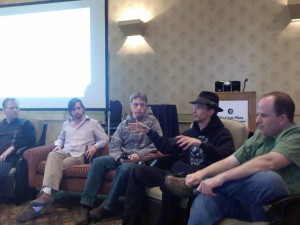
Interested in OSS, I volunteered to create video archives of the event. Downloadable and Creative Commons licensed recyclable copies of the video coverage can be found on Internet Archive. (Anyone without full Flash support in their browser might need to access the lectures that way.)
But for YouTube hosted copies, I decided to experiment with YouTube Annotation Hyperlinks. They allow you to link from within one YouTube video to another. This allows me to show a brief summary of every event, and let the viewer click through if they would like to learn more.
For anyone denied YouTube Annotation Hyperlinks (currently not supported by iPhone or iPad), here’s an index of lectures. Clicking will open the appropriate YouTube video’s landing page, where you can either watch it, or find embed HTML if you’re looking to propagate your own lecture.
TEDxYYC – Calgary’s TEDx Videos
Posted by gordonmcdowell in Alberta, Calgary, Canada on 2010-03-10
I’ve finished editing all the TEDxYYC videos, but they’re not yet indexed on the official TEDxYYC website. Until they do, the 2010 TEDxYYC videos can either be found at YouTube’s TEDxYYC Playlist, or right here (in chronological order)…
Rick Castiglione – Storytelling
John Manzo – Third Wave Coffeehouses
Chris Turner – Great Leap Sideways
Decidedly Jazz Danceworks – Wise Apple
Jennifer Martin – Innovative Spaces
Garnette Sutherland – Imaging, Robotics and Surgery
Eden Full – Changemaking & Solar Panels
Lorrie Matheson – Creative Process
Ben Cameron – Live Performing Arts in the 21st Century
Ruben Nelson – What Calgary Must Become
Dan Lui of BNetTV.com provided me access to additional coverage (footage swap!), and access to BNetTV’s mixing board audio. And thanks to Sarah Blue for letting me capture the event.
Oil Sands Extraction – LFTR in Alberta?
Posted by gordonmcdowell in Alberta, Calgary, Canada, Environment, thorium on 2009-11-23
THORIUM REMIX 2009 has been well received, so I’ve cut it down further to 10 minutes and put the subject in a Canadian context: How about using a liquid-fluoride thorium reactor to power oil sands crude extraction?
Bill Dickie (Alberta Minister of Mines and Minerals 1971-1975) pointed out the Stelmach government just polled 1024 Albertans and found only 25% object to new nuclear projects…
Calgary Herald: Alberta would welcome private nuclear power, Stelmach gov’t says (excerpt follows)
The Stelmach government opened the door Monday to nuclear power in Alberta — rejecting a moratorium and saying it will consider the controversial energy option on a case-by-case basis — but vowed no public dollars will be invested in any project.
The province announced its nuclear power policy the same day Energy Minister Mel Knight rolled out the results of the province’s public consultation on the issue. A telephone survey of 1,024 Albertans, which incorporated input from stakeholder groups, found about one-quarter of people want the government to refuse projects. Two in 10 said the province should encourage proposals and 45 per cent of people polled want nuclear power plants considered on a case-by-case basis.
With those numbers in hand, Knight said Monday that Alberta is open for business on nuclear power. But he stressed the province won’t cough up a penny and hinted the lack of subsidies might dissuade companies from proceeding in Alberta. “We’re not putting a moratorium on nuclear,” Knight told reporters. “We are not proponents of nuclear energy,” he added. “We need power and proponents that want to build (nuclear) in the system in Alberta are welcome to do so.”
Premier Ed Stelmach, however, said Monday in his “Ask Premier Ed” online video that nuclear energy is a “viable option” in Alberta.
“This is one way of keeping down the carbon footprint,” Stelmach said, noting the United States is “very high” on nuclear energy.
The premier acknowledged nuclear waste is a worry for many, but said new technology is key to addressing concerns.
I’m got some useful feedback on REDDIT, and forum pertaining to LFTR’s potential in Alberta…
Depleted uranium can be used as fuel in fast reactors. However, it is not usable in CANDU. CANDU is a thermal reactor, not a fast reactor: it does not breed fuel. It runs on fissile U-235. It can run on (0.7% U-235) natural uranium because it is very efficient at using U-235, not because it burns U-238 (not self-sufficiently, anyway). Conventional reactors are extremely wasteful, as they throw away over 99% of the starting material (because they can not feasibly burn U-238). A closed fuel cycle, with reprocessing and fast reactors, increases fuel efficiency by 100x – hence decreases fuel demands by 100x, and waste production by 100x. The transuranic elements, the most important of nuclear waste, are not left over but are consumed as fuel. Fast reactors can import these waste components from other reactors and burn them. They are waste incinerators. Thorium fuel cycles are basically the same – substituting U-238 with Th-232, and Pu-239 with U-233. They have the same basic advantages as plutonium-cycle fast reactors – fuel efficiency, waste burning. - deleted
Somewhere around 1/3 to 1/2 of a barrel of oil is needed to extract 1 barrel of oil. This is a very significant amount. I can not speak for other people. My primary concern with nuclear reactors are the usual concerns about cost, fuel production, safety, disposal, and cost. If the benefits of nuclear can be had without the drawbacks, then I will dance a little jig. It’s the promise of fusion, after all. - MechaBlue
Canadians are slightly anti-nuke, but the primary problem is that the oil companies already own the natural gas. They just drill a hole and it comes out of the ground to be burned for free, so from their point of view why would they use nuclear? They used to burn natural gas off as waste. You would have an easier time selling the idea of a Thorium reactor in terms of providing people with cheap power. Even then, in Alberta, the “lines provider” will be taking most of the profit from delivering that power. The reason why consumers are stuck with heavily polluting mines and power generation is primarily political. The current generators have used regulatory means to exclude newcomers because it isn’t in their best interest to lower their profits. - raghead
Use of nuclear energy for in situ gasification of coal (via high temperature steam) could reduce mining deaths. High ash coal deposits could also be exploited. Non-volatile poisons could be left in situ and the gas could be cleaned of volatile poisons and suspended matter before use. The process may also be feasible as an alternate for bitumen deposits like Alberta sands. - jagdish
Indian thorium solid fuel fast breeder will be up in 2011 at Kalpakkam This is unrelated to LFTR, which is a thermal spectrum reactor working with liquid fuels. - tt23
2011-10-21 Update:
THORIUM REMIX 2011 is now complete. This is my recommended video resource for learning about the Liquid Fluoride Thorium Reactor (a type of Thorium Molten Salt Reactor). It begins with a brief summary comparing LFTR to Pressurized Water Reactors (PWR).
Oil Sands Debate with Elizabeth May
Posted by gordonmcdowell in Alberta, Calgary, Canada, Environment, Politics on 2009-11-20
“Is Oil Sands Development Ultimately Irreconcilable with the Environmental Agenda?” was the question posed by Calgary Enterprise Forum. The discussion was held at Calgary Petroleum Club featuring Elizabeth May, Deborah Yedlin (Calgary Herald columnist) and Murray Smith (Energy Minister 2001-2005).
Despite the plethora of oil patch executives, Calgary Greens and red wine, no fisticuffs took place.